One Packing Standard for Every DC: Why Localized Orchestration Breaks at Scale
Every box you ship is decided by a system that can’t see most of what it costs. Here’s why that happens, how it compounds with scale, and what a robust architecture looks like.
Most fulfillment operations have a packing problem, and they do not have full visibility over it, nor do they realize packing deserves a closer look.
Boxes that ship today are chosen by a system that can only see one aspect of what it costs. A warehouse management system (WMS) selects a box that fits the items and clears the cube threshold, without knowing what that choice would cost on the carrier side. A transportation management system (TMS) rates the shipment based on the dimensions it was handed, without any visibility into whether a different box would have landed in a cheaper rate bracket. The freight invoice arrives weeks later, and nobody traces it back to the box.
This isn’t just a technology failure. It’s an architecture one. Every system in a stack does its job, but none of them focus on the box itself. When an operation grows beyond one building, with more DCs, more 3PL partners, and more automation, the gap between what each system can see and what each decision actually costs compounds fast.
The fix isn’t optimizing each system. It’s changing where the decision lives.
Every Box Gets Decided by a System That Can Only See One Aspect of What It Costs
The standard fulfillment handoff hasn’t changed in decades. An order management system (OMS) gathers and routes orders and a WMS executes. Somewhere in between, a box gets chosen by whichever system fields the question, optimizing for whatever it can see.
The cartonization logic built into a WMS typically optimizes for box count and cube fit. The warehouse execution system (WES) optimizes flow, given the allocation. The TMS optimizes transport, given the pack. Each system is locally rational and right about its piece of the puzzle, but none of them are right about the overall order.
The costs that live outside any single system, such as negotiated rate cards, downstream labor, the corrugate the network burns in aggregate, and how efficiently the automation already on the floor is being used, never get reconciled. The pack that looks right from any one vantage point is routinely wrong for everything downstream.
This is localized orchestration, and it has survived every wave of fulfillment innovation: new WMS vendors, sophisticated execution systems, cutting-edge robotics, even on-demand packaging automation. Faster nodes executing on decisions locally don’t fix the problem. They accelerate it.
Speed without coordination accelerates inefficiency. Feed a million-dollar machine a locally optimized decision and you get locally optimized output at astonishing speed.
The Packing Standard That Lives in One Building Can’t Scale to Thirty
Scale compounds the problem. Add a second DC and the packing logic that worked in the first one has to be recreated from scratch: re-entered into a new WMS, configured by a team that may have interpreted the rules differently, and maintained in parallel from that point forward. It’s a resource drain.
Add a 3PL partner and the situation gets harder. The brand’s packing standards now live in a system the brand doesn’t control, updated by people the brand didn’t train, tracked through damage claims and freight invoices that arrive months later.
Most brands and 3PLs know this is happening. Very few have a mechanism to fix it, because the systems that make packing decisions were never designed to share them. Every WMS is an island of local capability. Run three buildings or three 3PL partners and the official packing standard lives in an email attachment where compliance is hoped for, and drift is discovered late, or not at all.
What This Looks Like at Scale
A global apparel brand operating more than ten distribution centers across four continents had this exact problem. Their WMS handled cartonization at each location, and at scale, it failed. Large mixed orders caused allocation errors, processing times were stretched to hours, and their IT team was already overloaded.
The packing standard wasn’t consistent across their 3PL partners, and there was no mechanism to change it across the network without rebuilding it site by site. Beyond cartonization, their WMS had accumulated adjacent jobs over the years, including routing orders to autobaggers and handling full case picks alongside mixed items. A clean replacement meant those tasks had to go somewhere too.
They needed a single decision layer that could see the whole operation at once and absorb the edge cases the WMS had been quietly managing.
Elevate the Decision Above the Node
The fix is not a smarter module inside each building. It’s a single decision layer above all of them - an orchestrator with control
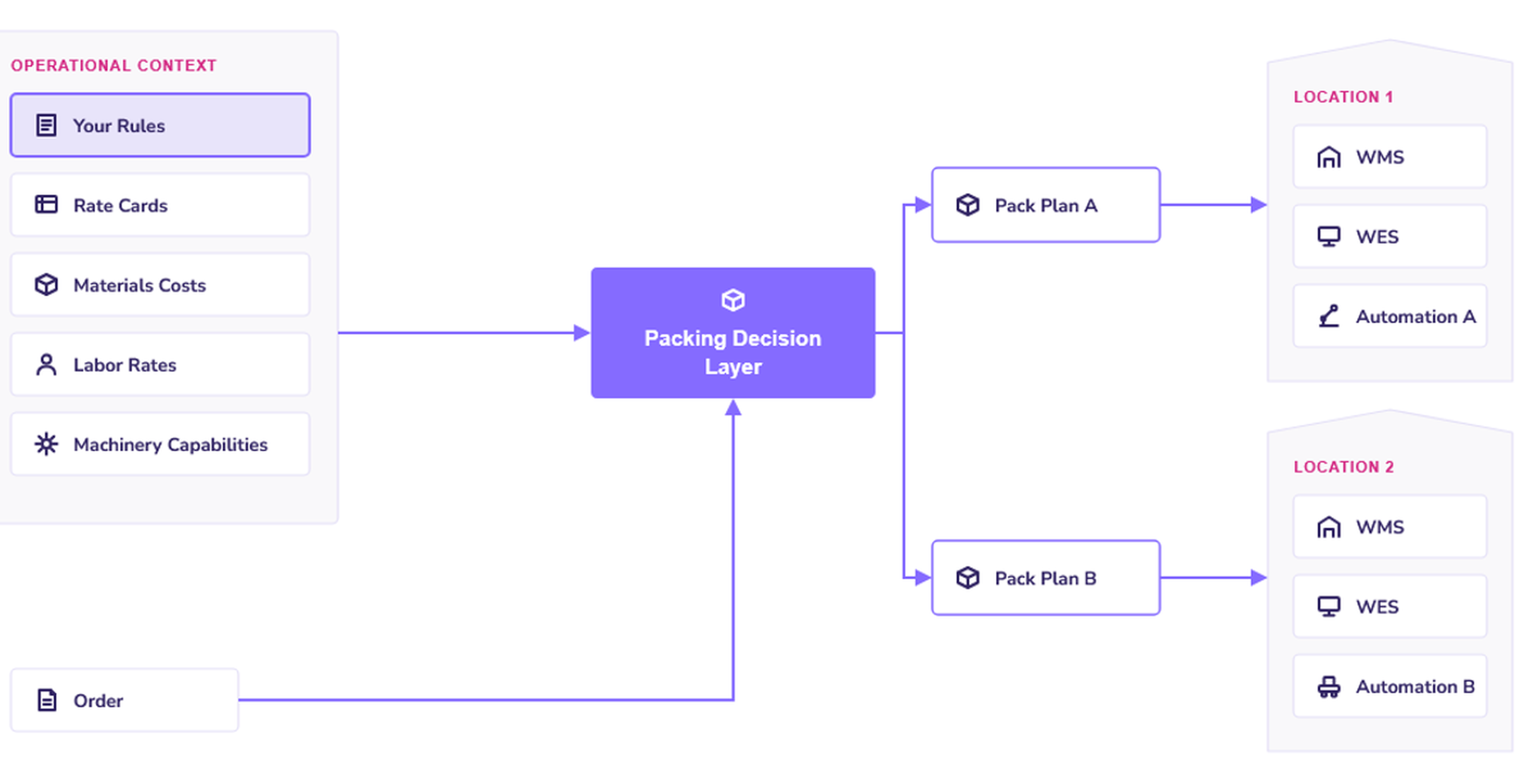
A Packing Control System (PCS) sits alongside the existing stack and holds what no single system holds: a picture of the complete cost for every order, before a box is chosen. Rate cards for every carrier and origin, material costs, downstream labor, and item-level rules all live within a PCS. Even the capabilities of every machine on the floor, from autonomous mobile robots (AMRs) to automated storage and retrieval systems (ASRS).
When an order needs a packing decision, from the WMS or the OMS at order import, the PCS answers with all of it at once. The existing systems, WMS, WES, TMS, all keep their jobs. The only thing that changes is what they’re working with: an already-reconciled pack decision, rather than a locally optimized guess. Because the decision lives above every node, it scales from one building to thirty without any rearchitecture. Different local systems, different WMS vendors, different automation at each site: the PCS applies the same packing standard everywhere it runs and doesn’t need to be maintained or updated via an email chain either.
What Changed for the Global Apparel Brand
Today, the PCS handles everything for this customer: cartonization, order splitting for allocation, full case pick routing, autobagger selection, and centralized item master management across all locations and 3PL partners.
Packing rules are managed by operations, not IT. One configuration change in PacManage™, a single source of truth for all packing SOPs, is live across every facility immediately, and the brand standard is consistent across every DC regardless of which 3PL operates it.
10+ distribution centers across four continents with two 3PL partners. There were zero IT tickets to make a packing configuration change across the network. This is what fulfillment looks like when the decision lives in a dedicated system for packing.
An Audit Worth Running
Before looking at new software, run an audit. Ask where packing logic currently lives in the operation, what it can see, and what it can’t.
If the answer is a WMS module at each site, maintained separately and updated through IT, that’s localized orchestration, and it’s costing something on every order that ships. The reconciliation across rate cards, materials, labor, automation, and downstream cost is where the money is. Most operations leaders feel it, and most stacks can’t do it.
One system, finally right about the order, is what changes that.