PPWR Compliance Exposes What's Broken in Your Packaging Process — Here's How to Fix It
The EU’s Packaging and Packaging Waste Regulation (PPWR) is often discussed in terms of sustainability targets and regulatory deadlines.
But for fulfillment operations, the impact is more practical. It changes how packaging decisions are made, measured, and justified. For many organizations, that represents a shift from a largely manual process to one that requires greater control, data-driven decision-making, and monitoring.
To explore what that shift looks like in practice, Paccurate’s Pat Powers was joined by Ben Hartley, Lead Quality Assurance Specialist at Packsize, and Sascha Kalytta Senior Consultant at Miebach Consulting.
The discussion, led by Paccurate’s Marketing Director Chelsea Tarr, focused less on defining PPWR and more on what it exposes inside packaging operations and what needs to change to meet compliance requirements.
Why PPWR Exists in the First Place
Chelsea Tarr: Let’s start at a high level. Why does this PPWR exist and why is it becoming such a focus now?
Pat Powers: We’re not here because a regulation just appeared. We’re here because of shipments like the one we all receive on a weekly, or for some daily, basis. It’s a universal problem.
When you open a large box, and there’s a small item inside with a lot of void fill, it’s easy to assume it was just a mistake. But inside an operation, it’s usually not that simple.
There’s time pressure, box sizes that don’t match the order profile, inaccurate or missing item dimensions, and infrastructure constraints. All of those factors come together, and you end up with a result that is far from optimized.
PPWR is trying to address that gap. Not just reducing packaging waste, but requiring that packaging decisions can be explained and justified.
Why Packaging Processes Break Down
Chelsea Tarr: If inefficient packing is such a common issue, why does it keep happening? Why aren’t packaging processes more optimized today?
Ben Hartley: A lot of it comes down to how packing processes are set up. In most operations, the priority is getting orders out the door. Packaging decisions are made quickly, often with limited information, and there isn’t always time to evaluate the most efficient option.
You also see challenges with fixed box assortments and data that isn’t always accurate. When those constraints exist, it becomes difficult to consistently improve packaging efficiency or reduce the empty space ratio.
It’s usually not intentional. It’s a byproduct of how the system is designed and what the operation is optimizing for.
That makes packaging optimization harder to achieve without changing the process itself. It is not just about selecting different boxes or materials, but about creating a more consistent and repeatable way to make packing decisions.
Why There Isn’t a Single Fix
Chelsea Tarr: When companies start thinking about PPWR compliance, is there a single solution they should be looking for?
Pat Powers: For a regulation like this, there isn’t a single solution that solves everything. Every operation has different constraints, different packaging, and different requirements.
Software can help determine how an order should be packed and which packaging to use. That’s where cartonization and packaging optimization come into play. Even though it helps you pack efficiently, software alone can’t physically create the packaging.
Sascha Kalytta: On the other side, hardware gives you flexibility. You can create right-sized packaging and reduce void fill, but you still need the right inputs and decision-making to make that effective.
When combined, these approaches support a more complete packaging process:
Cartonization to improve packing decisions
Right-sizing packaging to reduce empty space
Automation to execute consistently
Data to measure packing performance
When you bring those pieces together, you get much closer to a process that can meet compliance requirements. A consultative approach to build the right system for the size and scale of your operation is the best next step.
What the 50% Empty Space Requirement Means
Chelsea Tarr: There’s been a lot of focus on the 50% empty space requirement. How should companies think about that in practice?
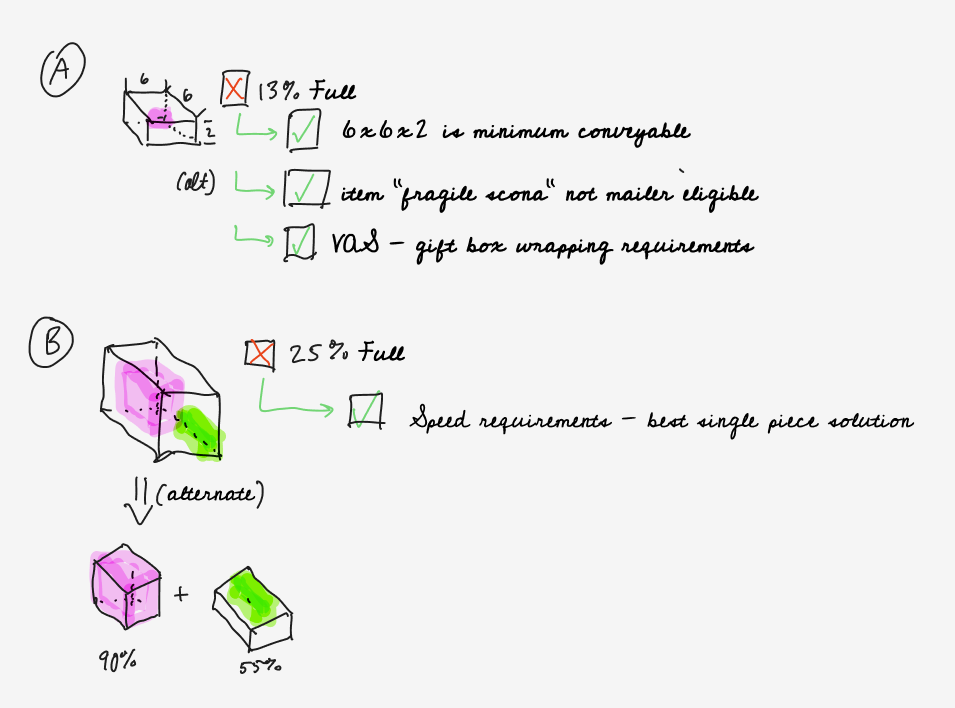
Pat Powers: Even with a well-optimized process, there will be shipments that don’t meet the threshold. That doesn’t automatically mean they’re non-compliant.
The focus is not just on the outcome, but on how the decision was made. If you can show that you selected the best packaging option based on the information and constraints you had, that’s what matters.
This is where packaging compliance becomes more data-driven. Companies need visibility into how packaging decisions are made and the ability to demonstrate that those decisions were optimized.
The Risk of Non-Compliance
Chelsea Tarr: What about risk? What happens if companies aren’t compliant?
Sascha Kalytta: The biggest risk is operational. If you need to make changes quickly, it can disrupt your processes and impact your customer experience.
Ben Hartley: There’s also the possibility of shipments being rejected if they don’t meet requirements, especially when crossing borders.
Pat Powers: If compliance information is required and you don’t have it, the shipment may not be accepted. It becomes a very straightforward check.
This shifts the focus away from fines and toward business continuity. Packaging compliance becomes something that directly affects the ability to ship orders without interruption.
Why Waiting Creates More Risk
Chelsea Tarr: For companies that are just starting to think about this, when should they begin preparing?
Sascha Kalytta: This isn’t something that can be implemented quickly. Depending on the operation, it can take one to two years to fully plan and implement the right approach.
That process includes:
Understanding current packaging performance
Establishing baseline metrics like the empty space ratio
Evaluating packaging strategies and technologies
Implementing packaging optimization and automation
Training teams to follow a more standardized process
Starting later increases the likelihood of having to make changes under pressure, when fines are established and businesses will be at risk of penalties
What Changes in a PPWR-Compliant Operation
Chelsea Tarr: Looking ahead, what actually changes for operations that adapt to this?
Pat Powers: Manual packaging decisions become much harder to justify. You need a way to consistently make the best possible decision, not just rely on experience or judgment.
That represents a shift toward packaging as a measurable and optimized process, rather than a final step in fulfillment.
And while this is an EU regulation, it’s unlikely to stay isolated. When something like this proves effective, it tends to influence other regions as well.
The Takeaway
PPWR compliance is not introducing entirely new challenges for fulfillment operations but rather shedding light on issues that have existed for years.
Inefficiencies such as excess void fill, inconsistent packing decisions, limited visibility into packaging performance, and outdated processes, are no longer just tied to cost or sustainability goals. They are directly tied to compliance.
For fulfillment leaders, that makes packaging optimization a more immediate and strategic priority.
To watch the full discussion, click here.